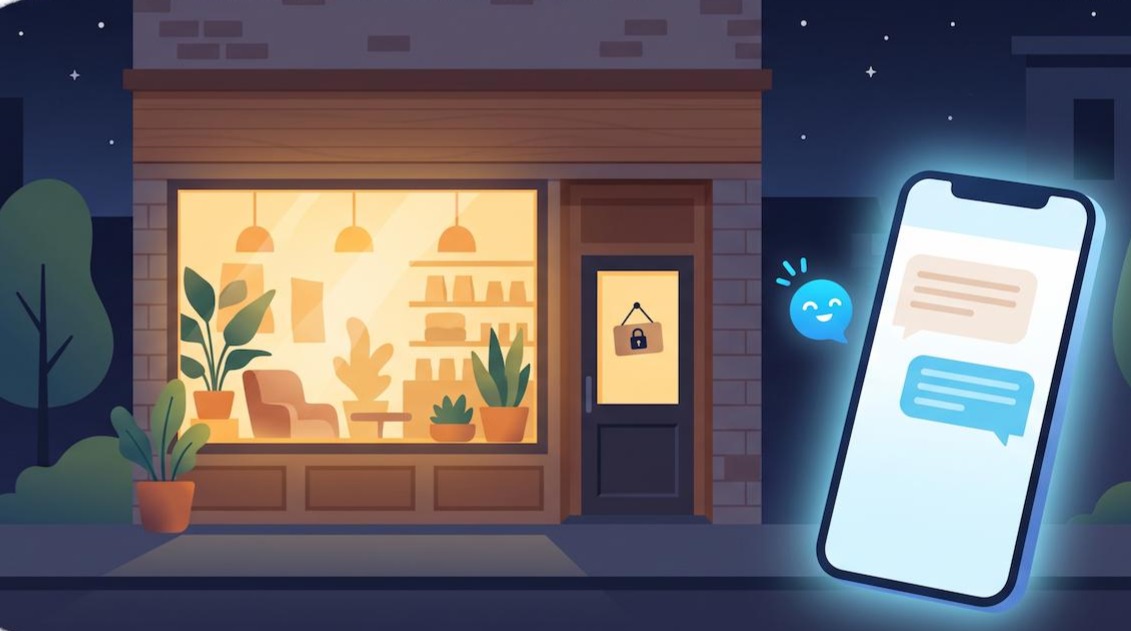
It's 9pm on a Sunday. Someone who's ready to spend money lands on your website, or sends a message to your WhatsApp, and asks a simple question — "do you have this in stock?", "can you do next Tuesday?", "how much for a party of twelve?". You're asleep. Your team clocked off hours ago. The message sits there, unread, until Monday morning.
By the time you reply, that customer has already asked two of your competitors the same question — and bought from whichever one answered first. You never saw the sale. You never even knew it existed. This is the quietest, most expensive leak most businesses have, and almost nobody is measuring it.
Whoever replies first usually wins
This isn't a hunch — it's one of the most consistent findings in sales research. MIT's lead-response study found that contacting someone within five minutes instead of thirty makes you roughly 100 times more likely to reach them and 21 times more likely to qualify them. The window is brutal: Harvard Business Review found that lead quality drops about 80% after the first five minutes.
And the punchline that should make every owner wince: around 78% of customers buy from the first business that responds. Speed isn't a nicety. It's frequently the whole game.
So how fast is the average business? Studies put the typical response time at over 42 hours. Worse, Forbes research suggests nearly a third of inbound enquiries are never followed up on at all. Read that again — not answered slowly, answered never. Every one of those was a customer who raised their hand and got ignored.
Your busiest shift is the one nobody is working
Here's the part owners underestimate. People don't enquire on your schedule. They message when they finally have a moment — after dinner, on the sofa, late at night, on the weekend. A huge share of buying intent shows up exactly when your business is dark.
You can't fix that by hiring. Nobody's staffing the phones at 11pm on a Saturday for a handful of messages, and you shouldn't have to. But every one of those messages is a real person with their wallet out and three other tabs open. The choice isn't "answer at midnight or answer at 9am." It's "capture that customer or hand them to a competitor."
They're not emailing you. They're on WhatsApp.
If you're in Spain — or really anywhere in southern Europe — there's a second leak hiding next to the first. Your customers live on WhatsApp. Spain has the highest WhatsApp penetration in Europe, around 91% of the online population, and business messages on it get opened 95–98% of the time, usually within minutes. Compare that to email, which most people ignore.
A chat widget that only lives on your website misses most of the conversation, because most of the conversation is happening on WhatsApp and Instagram. The businesses pulling ahead route every channel — website, WhatsApp, Instagram, Messenger — into one place, answered by one system, with one set of rules. The customer messages wherever they already are, and gets a real answer either way.
"But won't an automated reply just annoy people?"
It will — if it's a dumb one. We've all rage-typed "AGENT" at a bot that keeps offering us the wrong menu. That fear is legitimate, and it's exactly why this has to be built properly rather than switched on and forgotten.
A good system does three things a bad one doesn't:
- It answers from your real information, not generic guesses — your actual stock, prices, hours, and policies — so it's genuinely useful instead of confidently wrong.
- It knows what it doesn't know, and hands off cleanly to you or your team with the full conversation attached, so the customer never repeats themselves.
- It stays on a leash. Clear guardrails mean it won't invent a discount or promise a delivery date you can't hit.
Done right, the customer often can't tell whether they're getting an instant answer from a system or a fast one from a person — and they don't care, because their question got answered at 9pm on a Sunday.
What this actually looks like for you
Picture the same Sunday-night message, handled. The customer asks about availability. They get an accurate answer in seconds, any hour. If they're ready, the system books them in or takes their details and qualifies them — budget, dates, what they actually want — so that when you open your laptop on Monday you're not chasing a cold lead, you're following up with a warm one who's already half-sold. If it's something only a human should handle, it's waiting in your inbox with the whole thread, flagged and ready.
You haven't added a night shift. You haven't bought a tool you have to babysit. You've stopped leaking the customers who show up when you're closed — which, for most businesses, is a lot of them.
The takeaway
The expensive problem usually isn't the customers who complain. It's the ones who quietly message, get no reply, and buy elsewhere — and you never find out they existed. Replying first wins most of those sales, your customers are messaging at all hours and mostly on WhatsApp, and no amount of hiring covers that gap. A well-built AI chatbot does: instant, accurate answers across every channel, around the clock, that qualify and book the good leads and hand the rest to a human cleanly.
If you'd like to stop losing the after-hours customers you never see, take a look at ChatOctave — multichannel AI support with WhatsApp and your website handled out of the box — or get in touch and I'll map out what would actually move the needle for your business.